Just got back from Barcamp Nashville and it was fantastic this year! There were a lot less people this year, probably owing to the fact it was more development based, but I loved it for that all the more. The sessions were great and for the first time in years, I actually had to choose between the ones I wanted to see, as several of them were scheduled at the same time. Also, this was the first time I’ve ever spoken at a conference or in front of a lot of people about my craft! Unfortunately, this Barcamp was a little bittersweet as well, as it’ll be my last Barcamp Nashville for awhile, since we’re moving to London in a few months.
There was a lot less sponsor goodies this year, but they were holding some great sponsor activities, including two photo contests. I kissed a gnome in one and threw a canoe with Mitch Canter of Studionashvegas in another.
Some Good Times

I loved hanging out with Courtenay Rogers, who’s I’ve worked with before while she was at Primarily Rye, and has now brought me on the redesign of her new employer’s site, Bone McAllistor Norton. She did a beautiful job of organizing the event.
I also got to meet a Seth Green look-a-like and the guys from Industry Collective, which are a group of fantastic web professionals, who always make the coolest swag and come up with all of the fun Barcamp giveaways. This is where I ended up kissing the gnome. Cross your fingers and wish me well in winning an iPad2…I wants it!
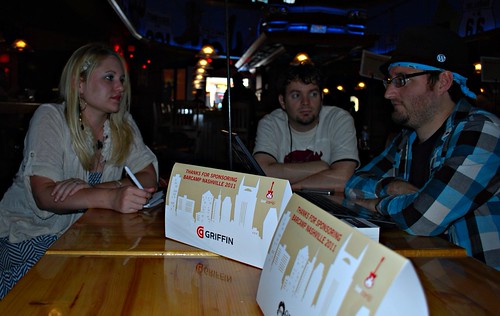
It was nice catching up with some other local freelancers I know well, Brad Blackman and Mitch Canter. It’s crazy how I’m literally 20-30 minutes away from these guys and we never talk!
Build a Native iPhone App in 30 Minutes or Less by Dick Pepper
I got in late to this one, but Dick was just telling us about using hybrid apps, which are apps that are build using HTML/CSS and placed into the Objective C framework, so that you can still have an app in the app store.
If you go this route, he suggested using UI frameworks, like Sencha or Webkit, to get the look and feel of an actual app.
Some frameworks tie into Objective C and are ideal for presentation focused apps. Content rich apps work better in HTML5. The cool thing about doing a hybrid app, is that you only have to support one browser and you can use all of webkit’s features, which makes the code a lot shorter.
UX Leadership: See, Speak Share by Laurie Kalmanson
Laurie spoke of everyday objects that had great UX: like the recent trend for car manufacturers to attach the gas cap to the car so drivers don’t forget it; or when a microwave beeps to alert you to finish food and then stays quiet. She noted that when machines got out of the way and did it politely, that was what a good user experience was. Good UX should be delightful and solve problems. It should also give people things they’ve never seen or imagined before.
Interfaces have beats like songs and in mobile, there are so many ways you can delight and surprise your users. Laurie pointed out some popular apps that have bad UX design, for example, Twitter’s header, Facebook’s privacy settings page and Google’s Gmail header.
The difference between IA and UX, are that IA’s (information architects) create outline focused designs, whereas those focusing on UX (user experience) include the visual design.
Let’s Talk About WordPress by Mitch Canter
A good introduction to WordPress, Mitch talked about reducing WordPress download times. He mentioned that the small additional server load that accompanies permalinks without the numerical date in the URL will be fixed in WordPress 3.3 (yay!). A use of a CDN (content delivery network), while ranging around $40 a month, dramatically reduces load time.
You should also use a caching plugin, which is a static screenshot of the site. He recommended W3 Total Cache. I stopped using WP Super Cache after I redid the portfolio and went ahead and tried out W3 Total Cache with his recommendation. It works right out of the box, which I like.
In WordPress, if you change the title you don’t have to change the URL. If you do however, you should use the plugin Redirection to set up htaccess redirects and avoid 404 errors.
Someone asked if the date in the URL was important to SEO, and Mitch replied it wasn’t that important.
Another user asked if there was an issue with having too many plugins – Mitch said a famously fast site had over 40 plugins installed. It’s not how many plugins you have, but how bloated the code in those plugins are. It’s the external calls to things like APIs that slow a site down.
Best Practices: The Worst Case Scenario by Josh Oakes
Josh Oakes did a fantastic talk on best practices. He stated that best practices aren’t what everyone else is doing, a consensus reality or what you call your opinion to end an argument. Instead, best practices is a standard way of doing things that can be used by people in different situations.
However, best practices have three problems:
- Specificity – What happens if you can’t adopt these practices? Best practices can not account for the unique knowledge required for or details of a problem.
- Baggage – Best practices bring baggage, for example, if it’s your punch list, you might state your goal, go through your list in a straight line and then bring in the assumptions and constraints that your best practice was designed for.
- Process – Doesn’t inclue anywhere to see if it actually worked. Best practices don’t help you to improve. It makes you really good at seeing problems that aren’t there and tricks you into thinking your work is good enough and needs no improvement.
To keep best practices from ruining a project, consider them, don’t just implement them at the start of a project.
Innovation is a byproduct: Why you don’t have to be innovative to be a great programmer by Jacques Woodcock
A fantastic rambling of a sem-drunk Jacques (hey it was the end of the day!), Jacques spoke about what innovation was and who had it. He said innovation could be a new idea, method or device or the creation of something better accepted by markets. Innovative companies include Apple, Tesla, Google, Disney, Nike and Whole Foods.
He also discussed a few flots: WebTV, AOL, Blockbusters, New Coke, HP Touchpad and the Zune (my contribution!).
What separates innovation from flops is the creation of a better process that solves the problem and has a great user experience. Apple doesn’t invent products, but instead creates a better product.
The US is no longer a product based economy, but is an IP, copyright and patents country. You used to have to invent something to get a patent, instead now you can just detail it on paper and be the first to file. This, unfortunately, covers software and forces smaller companies to compete in a race against larger ones.
Back to Apple! Jacques mentioned that both Android and the iPhone were innovative, they just solved different problems. Apple focuses on UX problems and providing rich features, while Android wanted to provide solutions, features and a quality competitive item.
In order to have an innovative solution, you need to understand the business goals of a company.
glass.Max() = The Rise of the Female Developer/Leader
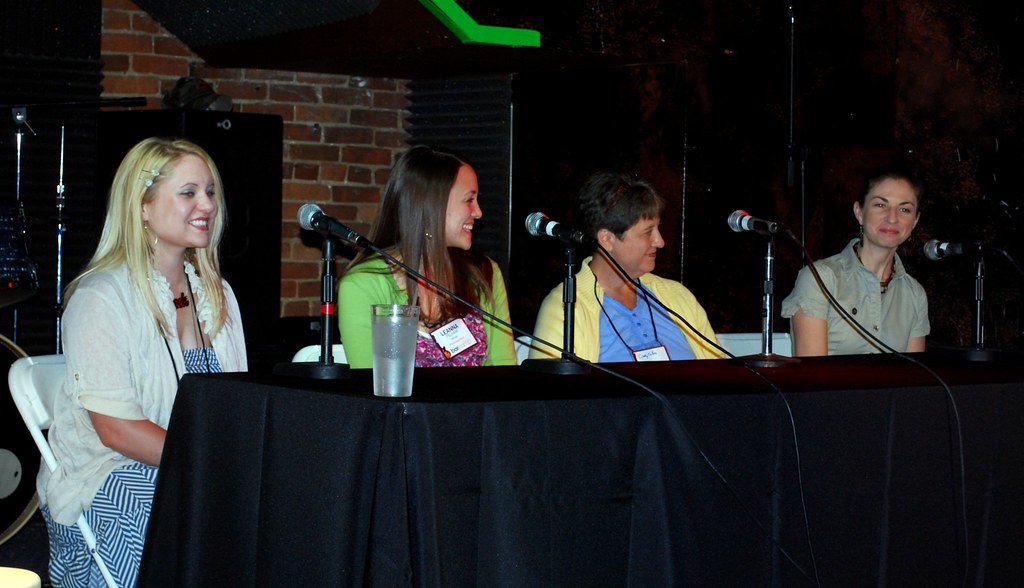
Moderated by Kenneth White, this was the first talk I’ve ever participated in! It was basically a panel of me and three other great ladies and we talked about getting into the tech field and the issues with being a female in a male dominated sector. I’m still looking for audio or video of our talk, so if you know someone who recorded it, please let me know!
Did you enjoy Barcamp?
Feel free to share your thoughts and photos!
Images by Dave Delaney and Wonderdawg777

Amber Weinberg
Amber is a freelance front-end developer specializing in semantic and accessible custom WordPress themes. She works with agencies and other freelancers to bring their designs to life using custom ACF flexible layout builds - making them more performant and less buggy while allowing the client easy customization without breaking the design system.